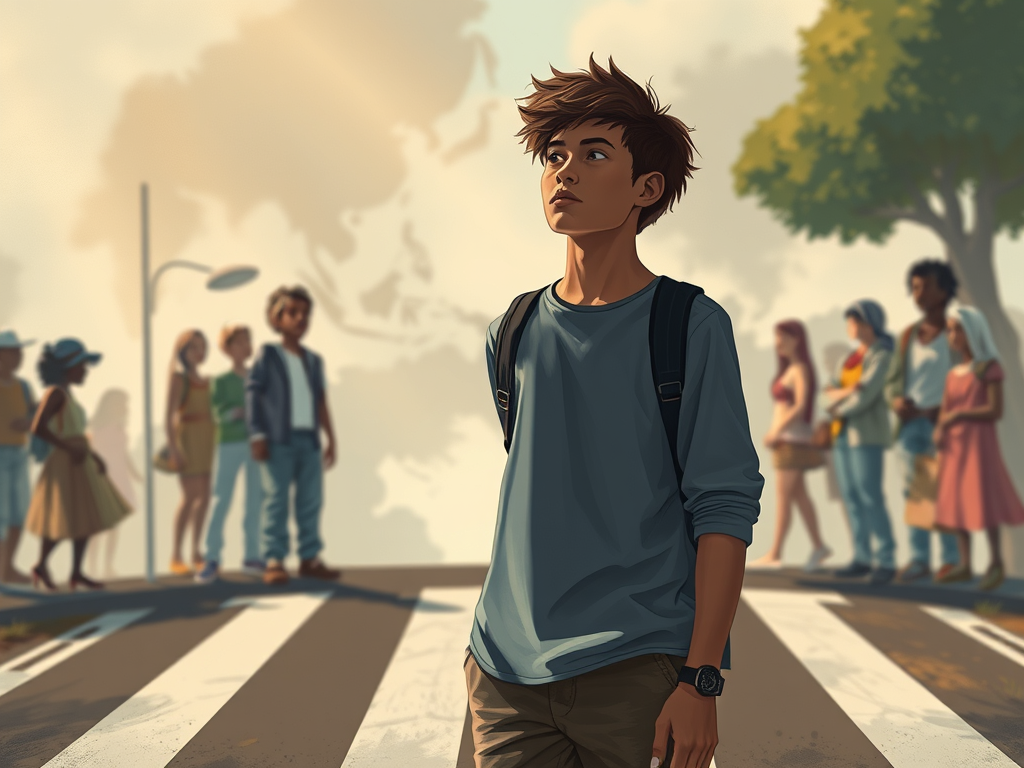
I spent a lot of time as a kid wondering who I was.
When you grow up in the foster care system, identity doesn’t come with a family crest or neatly passed-down traditions. Instead, it’s a question you carry everywhere. I used to wonder about my real family—were they rich or poor? Were they smart? Where did I come from, and what did that say about me?
I had light brown hair and freckles that confused people. I spoke in a way other Black kids said sounded “white.” And depending on which home I was placed in, my religion would change—I vividly remember one year practicing Judaism, Jehovah’s Witness, and Christianity all in the same twelve months. You learn to adapt. You learn to survive. But in the process, you also learn to question your identity at every turn.
Morals or Survival?
Looking back, I wonder if my early “morals” were really just survival instincts. I had a strong aversion to lying or stealing—not because anyone sat me down and taught me that, but because I desperately wanted to be seen as someone who belonged in society. I wanted to be good. I wanted to be accepted.
That said, those values stuck. Even when being honest made me look bad, I told the truth. I hated violence and, at one point in my life, I even committed to pacifism. Maybe they started as survival tactics, but they became part of who I am.
Hyper-Adaptability and a Fragile Sense of Self
When your identity is fragile—when you don’t know where you fit—you start to hide yourself. Or sometimes, you become hyper-individualized just to stand out, to prove you’re not invisible. I think that carried with me well into adulthood. I became good at code-switching, at mirroring others, trying to survive in rooms where I didn’t feel like I belonged. But the downside is it can seriously mess with your sense of self.
You can start to wonder: who am I really, when I’m not adapting to survive?
Learning to Choose Myself
Adulthood became the turning point. For me, building a real sense of identity started with asking:
What kind of person do I want to be when this life is over? What experiences do I want? Who do I want to have been?
That’s when I started taking control. I began connecting with communities that gave me a sense of meaning—whether it was people I met at the basketball court or others in the medical field. Pursuing medicine sharpened my focus on ethics, professionalism, and work ethic. I wanted to be someone people trust. I wanted to contribute. And I wanted to learn how to connect with people who were nothing like me.
I also started saying something I never had the courage to say before:
“This is who I am.”
Because I realized that growth wouldn’t come unless I accepted myself first.
I Still Struggle Sometimes
Even now, I struggle with self-worth. I look around at classmates who seem to know exactly how to navigate competitive fields like surgery. They move with certainty and confidence I didn’t grow up seeing. But I remind myself: I’m not here to copy anyone’s path. I’m here to build mine—based on the values I’ve earned through living.
And when you’re trying to enter a field like medicine—where stability, confidence, and polish are almost assumed—it can feel like you’re playing catch-up in every direction. I didn’t grow up learning how to network, how to ask for help, or how to even picture myself in these spaces. The grit is there, but sometimes the polish takes longer to develop. That gap, if unspoken, can quietly shape who makes it and who doesn’t.
You Don’t Need a Map to Move Forward
If you’re reading this and you’ve also grown up without stability—whether in foster care, trauma, or any other form of instability—I hope you know this:
You are not broken.
You haven’t been handed a blueprint, but that doesn’t mean you can’t draw your own. You can choose your values. You can become someone you’re proud of. For me, basketball helped. Medicine helped. So did a few faculty mentors who saw something in me. It all helped—but only once I decided to stop running from my story and start building with it.
Final Thoughts
I’ve moved homes 18 times. I’ve been praised in failing schools and humbled in elite ones. I’ve been an outsider in almost every room I’ve walked into. But I’ve also built something I never had growing up: a sense of who I am.
And I’m still building.
You don’t need a map to get where you’re going. You just need the courage to keep moving, and the honesty to make sure it’s really you walking the path.